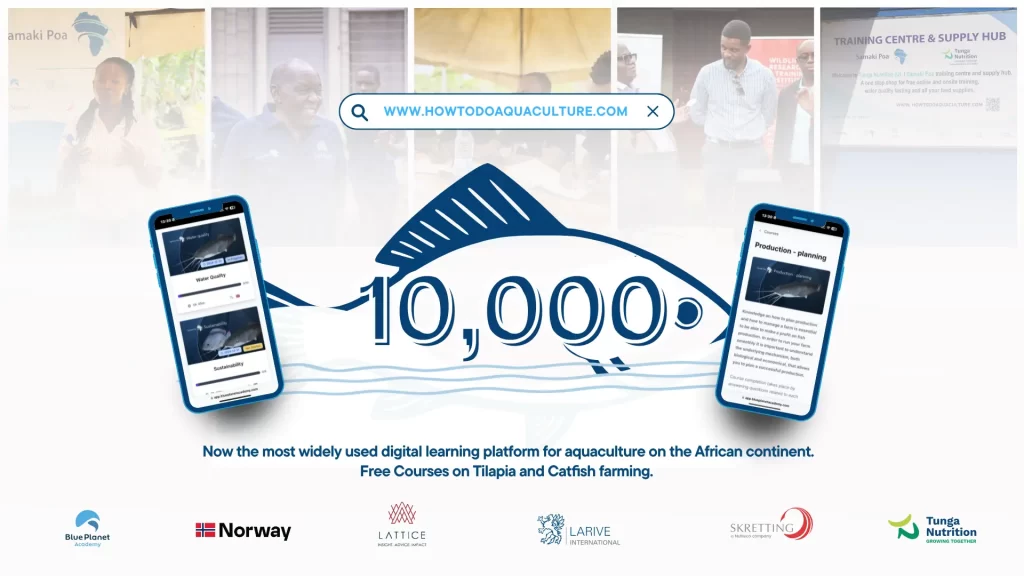
More than a number
Reaching 10,500+ users is meaningful, but the real story sits behind the headline figures:
- 3,400+ certificates issued across multiple practical aquaculture courses.
- 63,900+ learning videos completed in 2025 alone, demonstrating strong engagement and steady progress.
- A growing catalogue of high-quality, practical courses, covering fish farming fundamentals as well as specialised topics such as feed, pond management, biosecurity, and business skills.
Together, these results point to a clear demand for training that is accessible, hands-on, and immediately applicable, from pond preparation to production planning.
The partnership powering the platform
This achievement is driven by the Samaki Poa partnership, an intercontinental consortium featuring four main partners: BluePlanet Academy, Skretting/Tunga Nutrition, Larive International, and Lattice Aquaculture. The initiative is backed by a €2 million investment from the Norwegian Agency for Development Cooperation (Norad) for its 2022–2026 programme.
Importantly, the partnership strategy goes beyond digital learning alone. It integrates the platform with essential on-the-ground support to ensure farmers can translate learning into practice.
From online learning to on-the-ground change
Samaki Poa combines digital education with practical delivery mechanisms that strengthen adoption and inclusion:
- Practical training
Samaki Poa collaborates with Aquaculture Academy sites in Kenya and other hubs such as Gishanda Fish Farm in Rwanda to deliver intensive, hands-on courses. The goal is to train at least 1,200 farmers, students, and fisheries officers with practical skills they can apply immediately.
- One-stop hubs
To help bridge the digital divide, five “one-stop” aquaculture hubs are being established in Kenya, Uganda, and Rwanda. These centres are designed to provide:
- Access to quality feed and fingerlings.
- On-site training.
- Computer access to use the e-learning platform, particularly valuable for farmers without reliable internet.
This blended approach helps ensure that digital learning becomes a real-world improvement, not just completion statistics.